
A bedroom under 100 sq ft with one window is a completely different design problem than a big moody bedroom, and almost none of the dark academia posts out there admit it. Dark accent wall, stack of books, warm lamp, the end. Fine, but that advice works in a 200 sq ft room too, so it isn't really about your room at all.
So these 20 ideas are grouped by the small-room problem each one actually solves: wall-only ideas with zero floor footprint, the dead space over and under the bed, the single-window light problem, and furniture that earns its inches. Every idea carries an execution level too, so you know upfront whether it's a peel-and-stick swap, a weekend with a roller, or something you have to go shopping for.
One more thing, since it's late July and fall is the whole reason you're reading this. Most of this list is the year-round base. The actual September swap-in is short, and I've marked it as we go, so you're not rebuying a room every three months.
Group 1: Wall-only, zero floor footprint
1. Drench one wall and the ceiling in the same deep shade
 Save
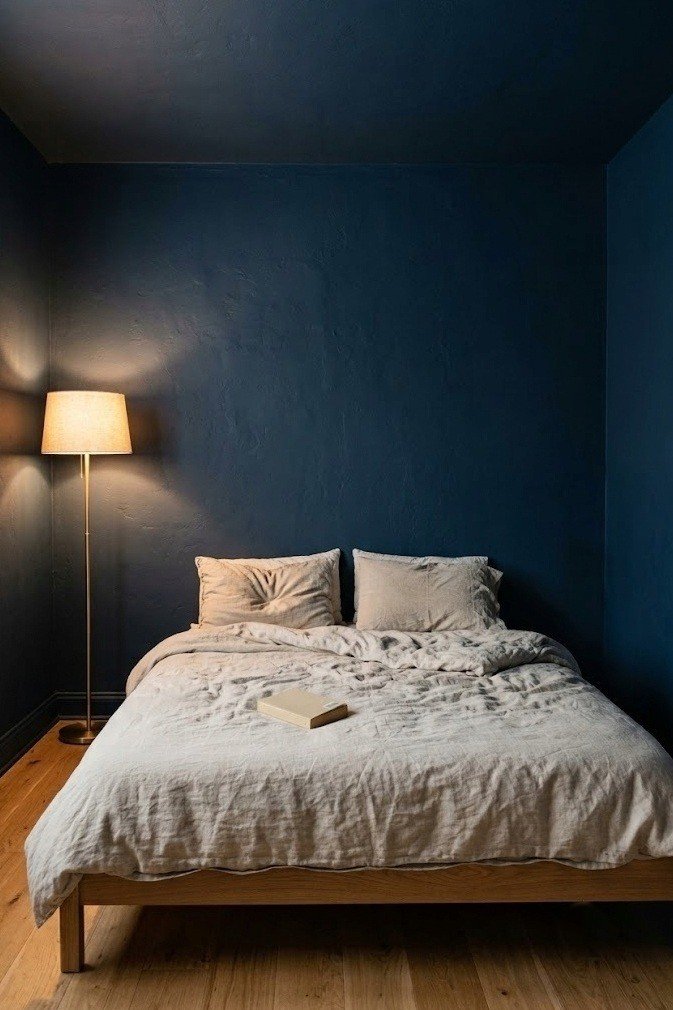
SaveHere's the counterintuitive bit: in a tiny room, taking the dark color up over the ceiling makes it read bigger, not smaller. Designers do this on purpose. When the matte navy runs from the wall straight across the ceiling with no break at the top, your eye can't find the corner where the room stops, so the boundary just sort of dissolves.
Ask for Benjamin Moore Hale Navy HC-154 if you've never lived with a dark bedroom before. It's deep enough to feel dramatic and soft enough that it doesn't turn hostile under a single window. Farrow & Ball Hague Blue leans teal and greener if you want more depth, and Sherwin-Williams Urbane Bronze is the brown-gray option.
Can't paint? Skip straight to Idea #2, or go through the no-paint version of this whole aesthetic instead.
2. Peel-and-stick wood plank on the headboard wall only
 Save
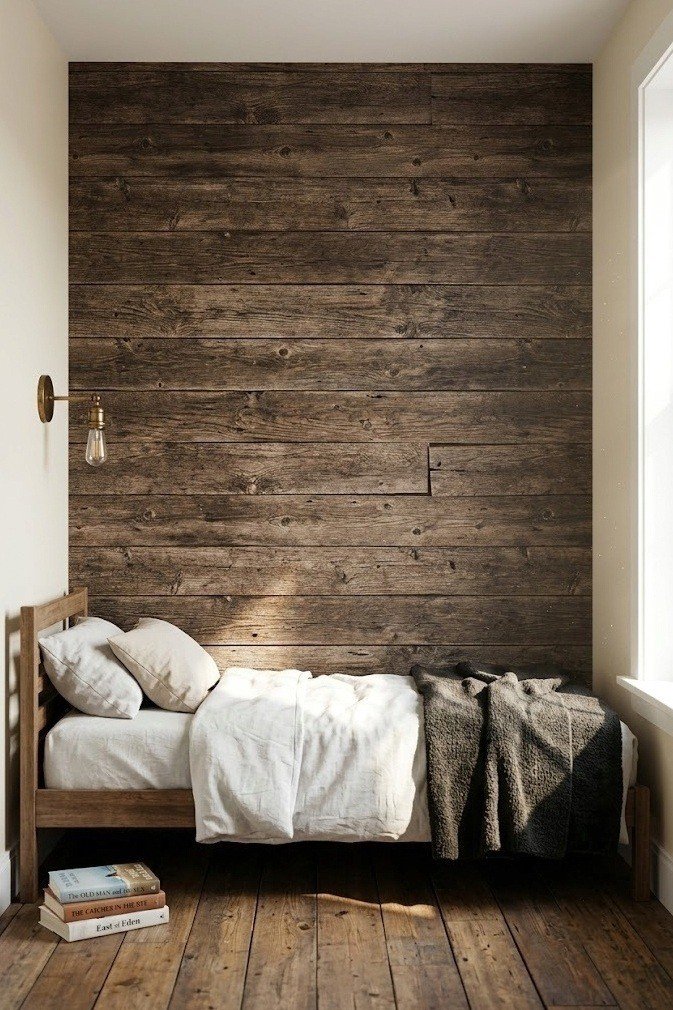
SaveWood paneling is the one dark academia move renters assume is off limits. It isn't. A dark brown weathered plank peel-and-stick paper covers a single headboard wall for about $35 a roll, and it lifts off clean at move-out.
The warning that nobody puts in these posts: textured walls kill the adhesive. Orange peel, knockdown, popcorn, any of it, and this will start peeling at the corners within a month. Run your hand over the wall before you order. Also give freshly painted walls a full week to cure first.
The aged brass sconce to the left of the bed is doing more for the mood here than a second lamp would.
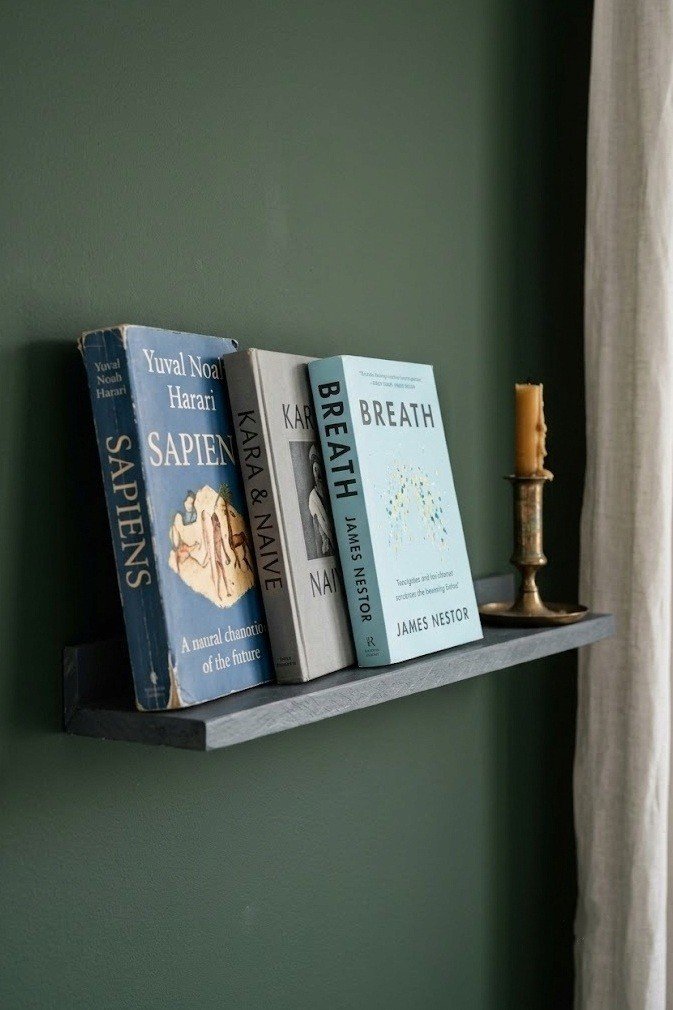
3. An adhesive picture ledge as a book rail
 Save
SaveFive pounds. That's the honest limit on an adhesive picture ledge, which is about four hardcovers and a candlestick, not your Penguin Classics collection.
Also, don't mount it over the bed. The instructions say so, and they say it for a reason.
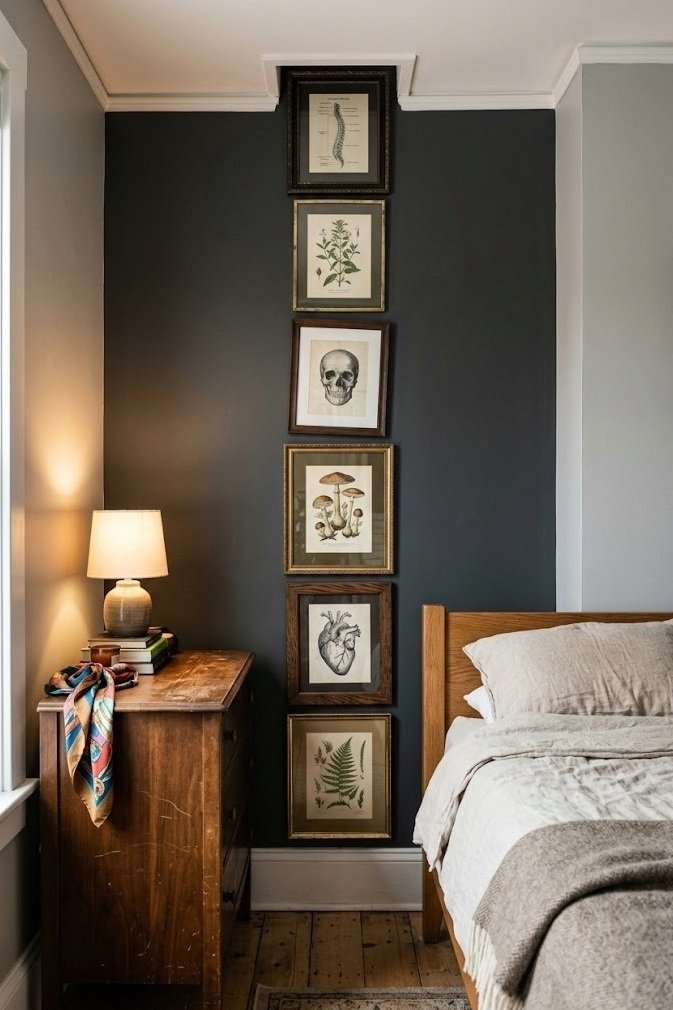
4. Hang the gallery in a column, not a grid
 Save
SaveA grid spreads sideways, which is exactly the direction you don't have. Stack the frames in a tight vertical column instead and the whole thing pulls your eye up.
Six mismatched dark wood and brass frames running from waist height to the ceiling read as one tall object rather than six small ones. Mismatched is doing real work there, by the way. Matching frames make it look like a furniture catalog; mixed ones look collected, which is the entire point of the aesthetic.
Command's large picture strips hold 16 pounds across four pairs, so framed glass is fine. Clean the wall with rubbing alcohol first and don't hang anything for an hour after. Ninety percent of "Command strips don't work" is skipped wall prep.
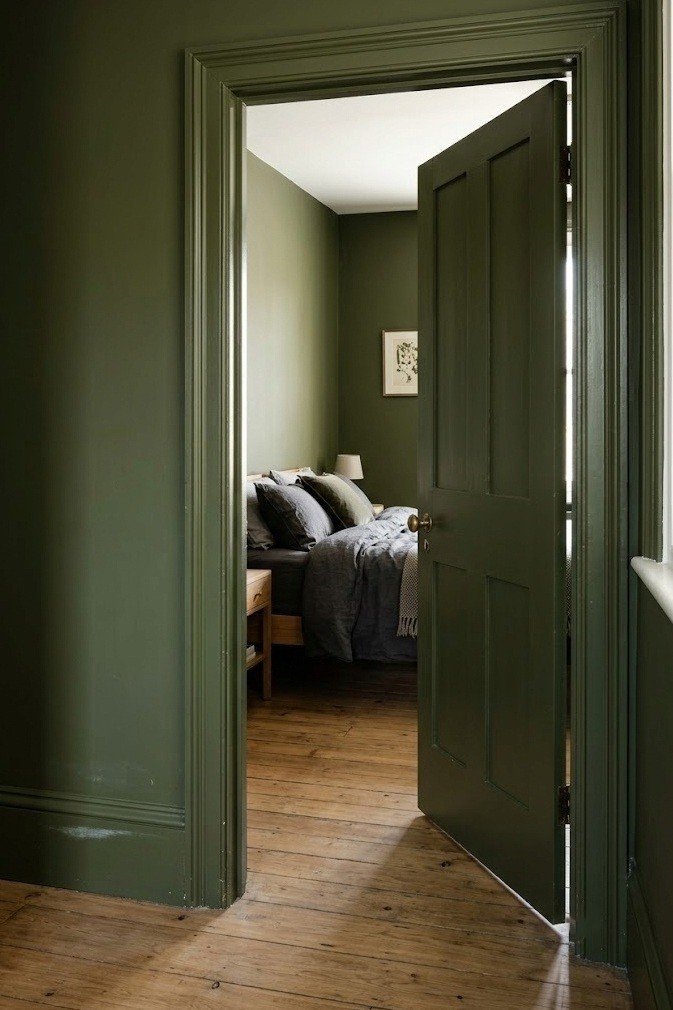
5. Paint the trim, the door frame and the door too
 Save
SaveWhite trim in a dark room is like white socks under short pants. Your eye stops dead at the line, and every stop makes the room feel smaller.
Same olive green on the baseboard, the frame and the door, satin on the woodwork against matte on the walls so there's a texture difference but no color break. In a room this size one quart usually covers the lot.
Group 2: The dead space over and under the bed
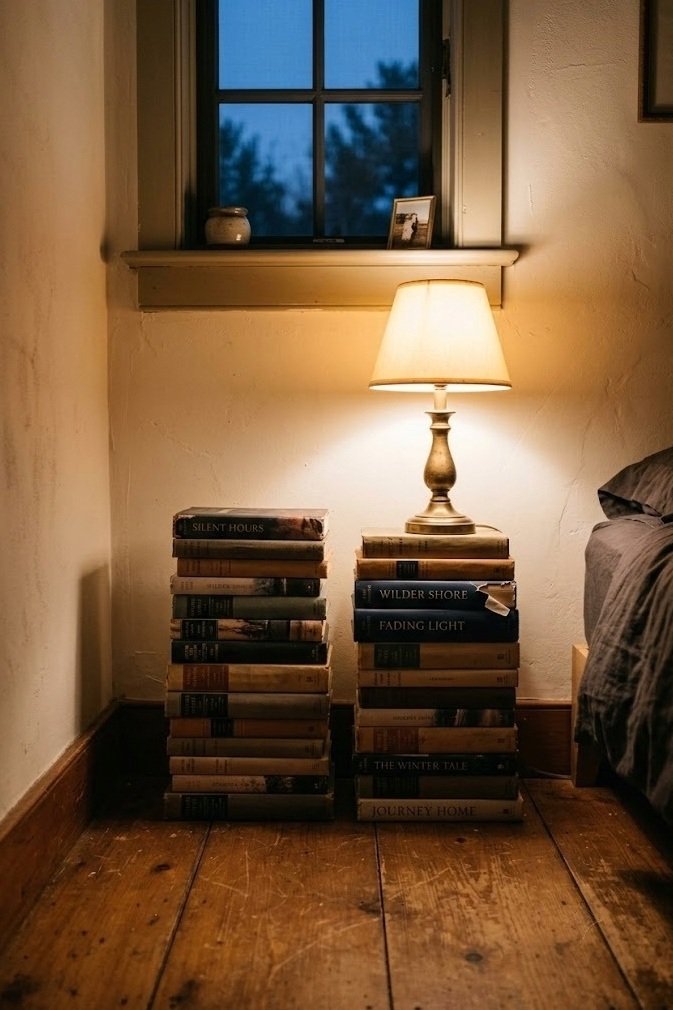
6. Stack books on the floor and call it furniture
 Save
SaveFree, no footprint beyond the books themselves, and honestly one of the better looking things on this list. Two knee-high stacks along the wall under the window, brass lamp balanced on the taller one. That's it.
7. Rolling crates in the six inches under your bed
 Save
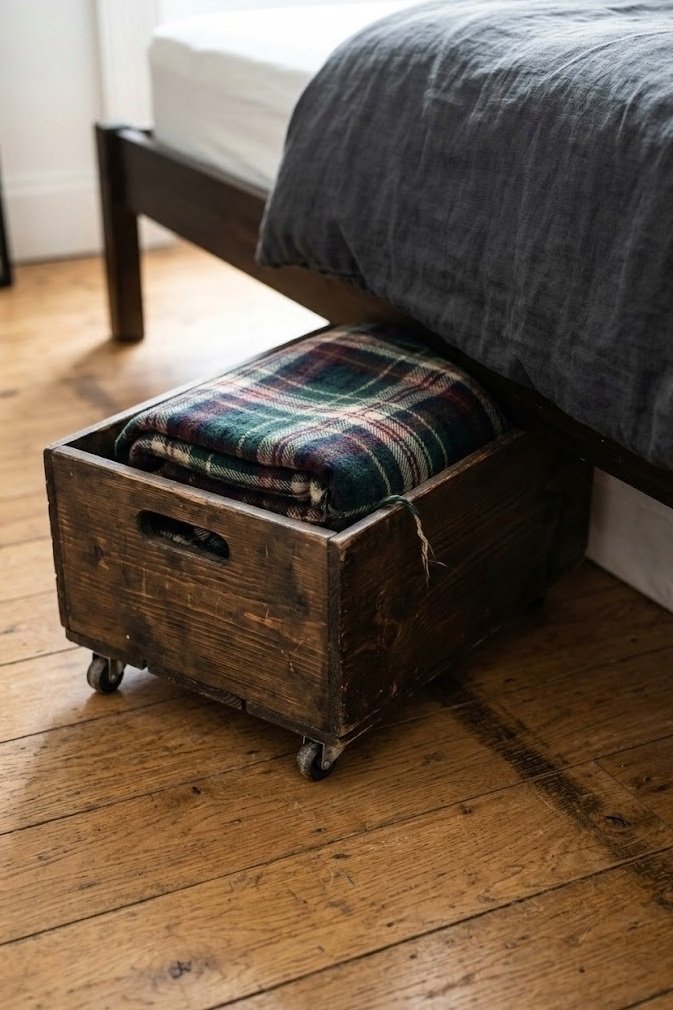
SaveBed risers get mocked, but in a sub-100 sq ft room the space under your mattress is the only storage you own that you're not using yet.
Dark stained crates on castors slide out for the plaid wool blanket you only want from September onward, then slide back so the floor stays clear. Measure your clearance before you order anything. Crate height and bed clearance almost never match on the first try, and a crate that's an inch too tall is just a crate you keep in the corner.
September swap: this is where the heavy blanket lives for the other eight months.
8. The shelf above your door
 Save
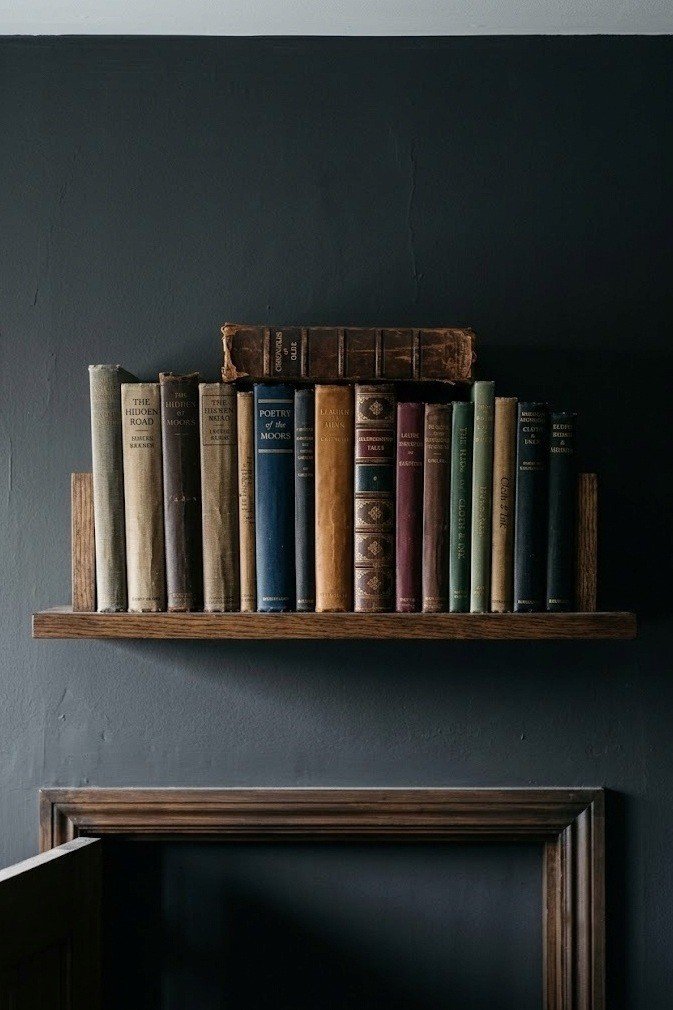
SaveRoughly a foot of wall above the door frame sits empty in every rental in the country. One narrow shelf up there holds a row of cloth-bound and leather-bound books and reads like an architectural detail instead of storage.
Fair warning, this is the one idea in this group that needs actual screws, so it's not renter-safe in the strict sense.
9. A headboard that mounts to the wall instead of standing up
 Save
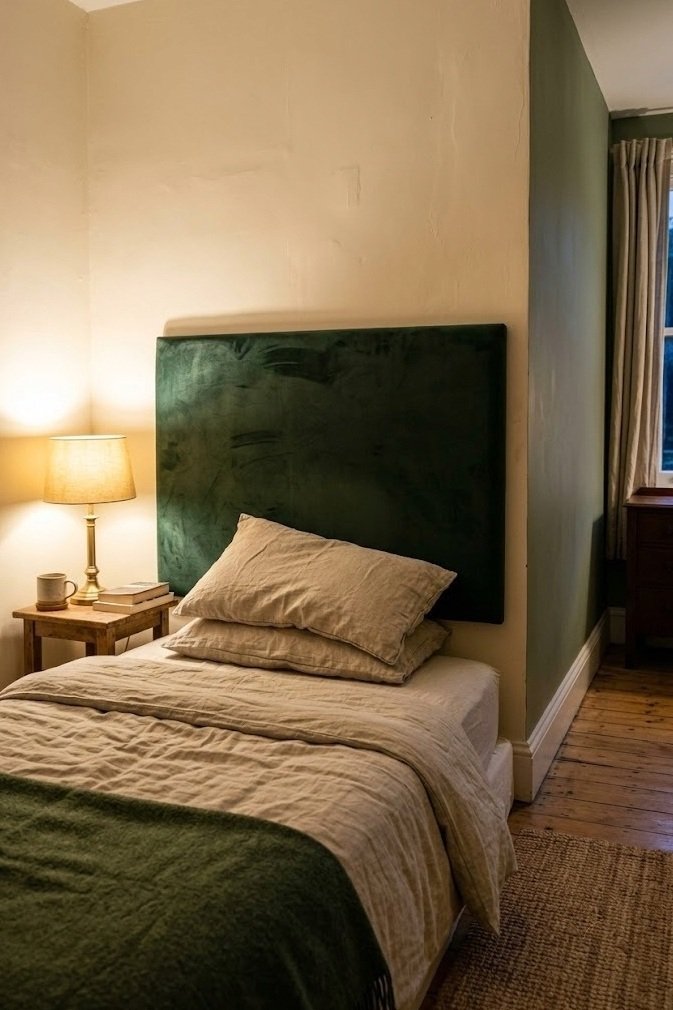
SaveA freestanding headboard pushes your mattress a few inches off the wall. In a room where the walkway is already tight, those inches are the whole difference between shuffling past the bed and walking past it.
Mount a dark green velvet panel flat to the wall, push the bed right up to it, and the frame disappears from the equation. Low contrast against a dark wall keeps it from looking like a bolted-on rectangle.
10. Turn a closetless corner into a curtained one
 Save
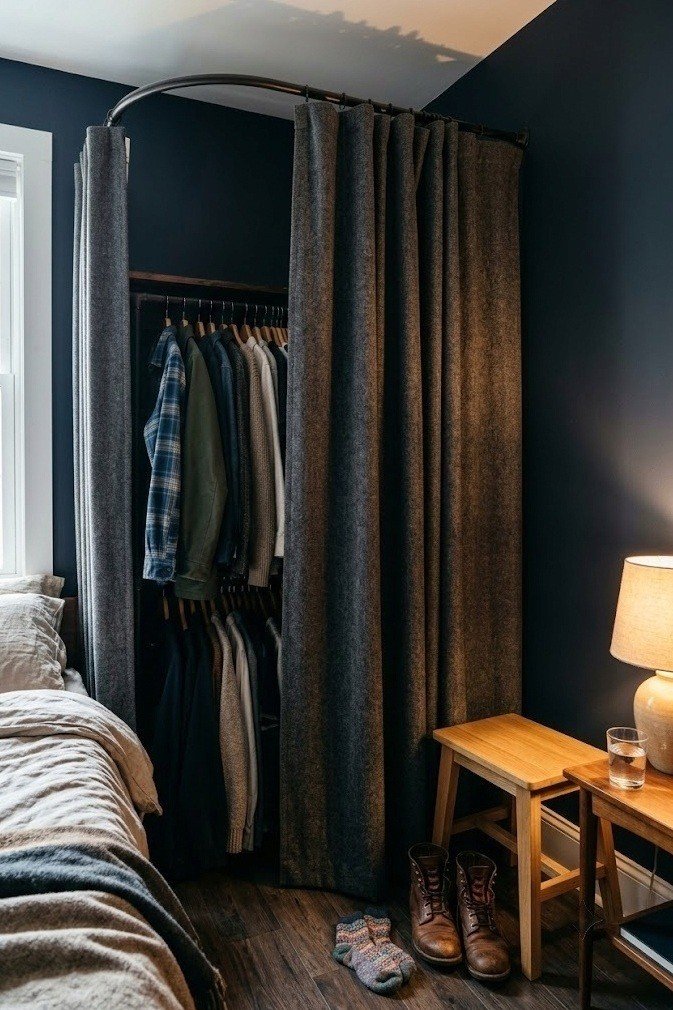
SaveMost small dark academia bedrooms fail at the closet, not the walls. All that moody styling and then a bare clothes rail sitting in the corner like a retail fixture.
A corner tension rod and one heavy charcoal panel turn that rail into a soft wall, and in a dark room a curtained corner reads deliberate rather than temporary. Test the corner first though. Tension rods need two solid perpendicular surfaces, and a drywall corner with nothing behind it will let go at 2 a.m. for no reason at all.
Group 3: The one-window problem
11. Mount the curtain track at the ceiling and run it wall to wall
 Save
SaveThis is my pick from the entire list. If you only do one thing, do this one.
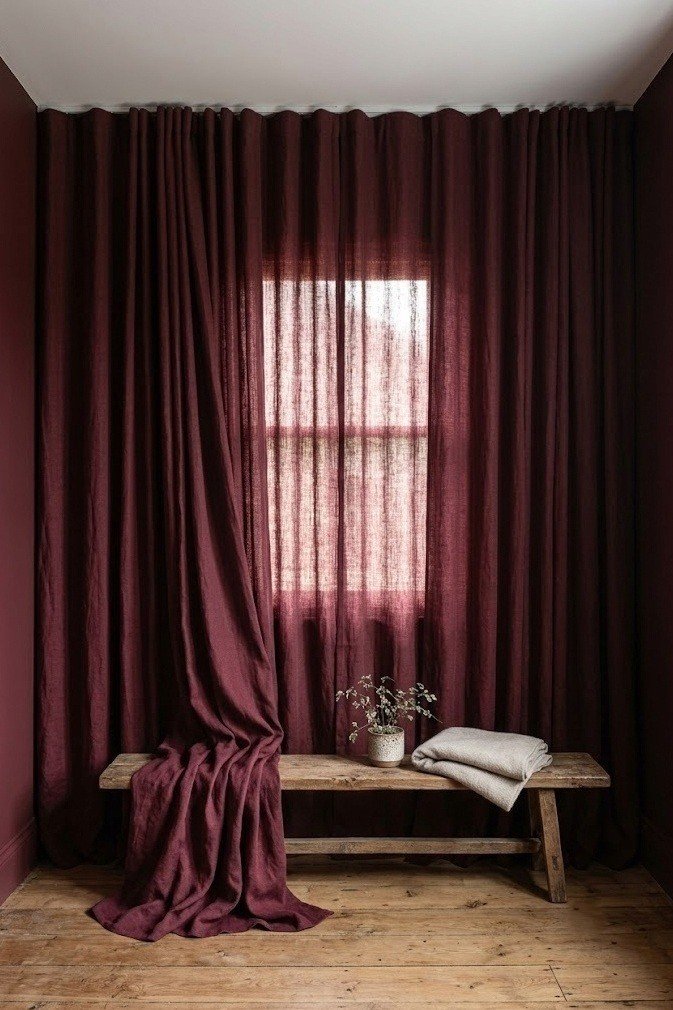
Rod at the ceiling, not above the window frame. Panels running the full width of the wall so nobody can tell where the window actually ends. Then match the drape color to the wall, burgundy on burgundy here, and the room stops announcing that it has one small window on one short wall. Floor-length, always. A drape that stops at the sill in a small room looks like a kitchen.
Burgundy suits fall specifically well, and there's a whole burgundy bedroom breakdown if that's the direction you're leaning.
12. The bulb number nobody gives you
 Save
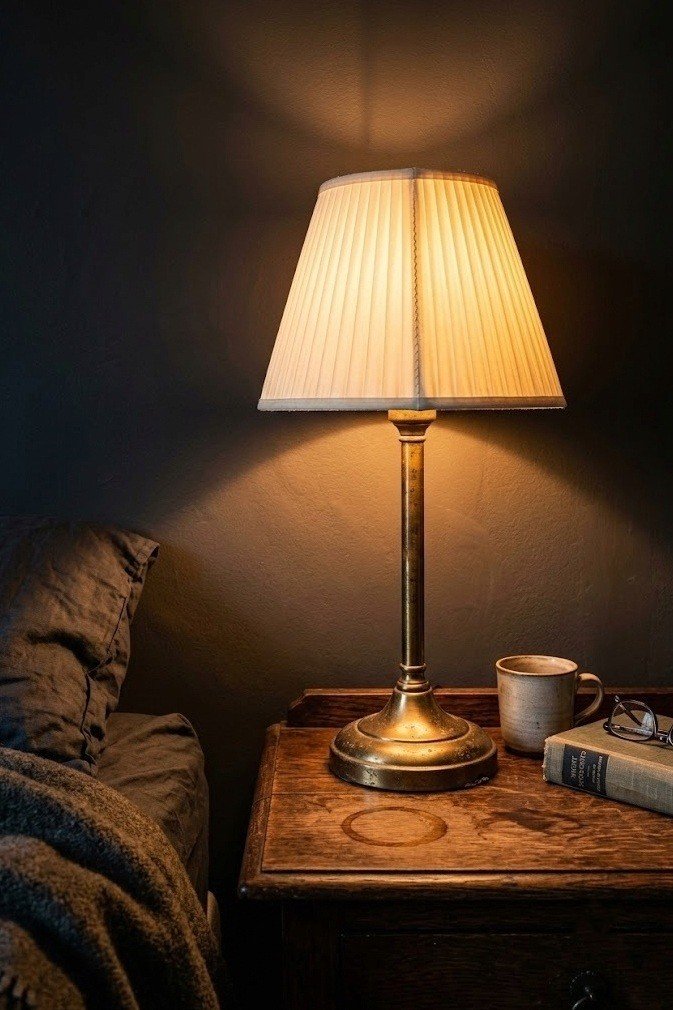
SaveEvery post says "warm lighting" and not one of them gives you a number. It's 2700K.
That's the warm incandescent glow, and it's the standard default for bedrooms. Go cooler than that and a dark room starts looking like a parking garage at night. Put 2700K in the ceiling fixture and in every lamp, and keep them all matched, because two different temperatures in one small room is instantly visible.
Look for CRI 90 or above if you can find it. Deep greens and dark browns go muddy and gray under cheap low-CRI bulbs, which is a lot of why some dark rooms photograph better than they look in person.
September swap: add one 2200K bulb to a single lamp. That's roughly candle temperature, and it's the difference between a dark room in July and a dark room in October. One bulb.
13. Clip the reading light to the bed frame
 Save
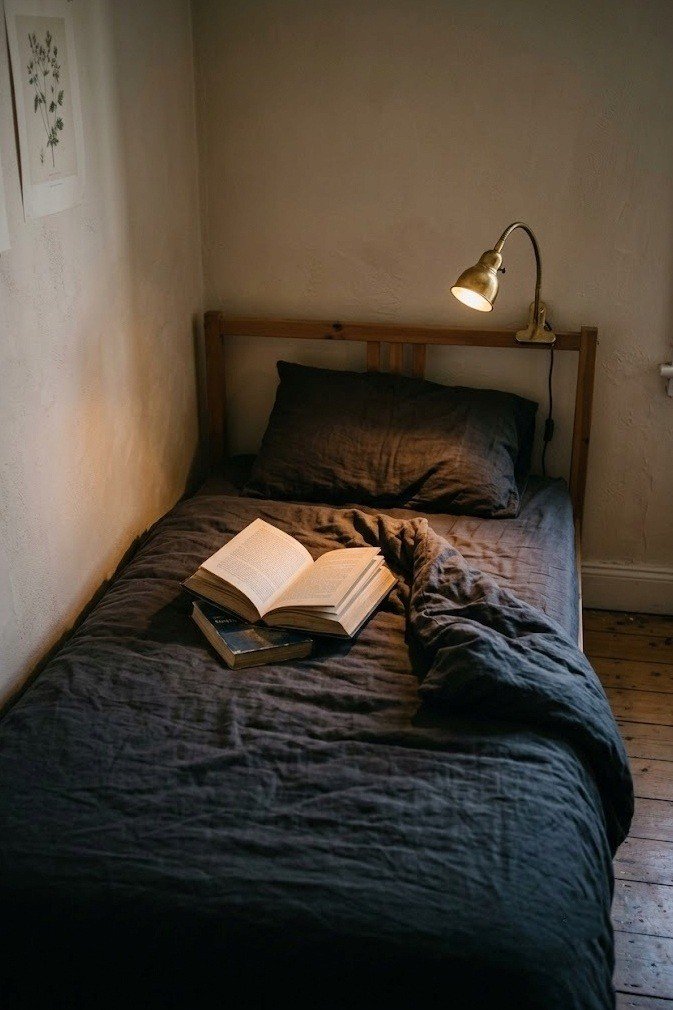
SaveNo nightstand, no problem. A brass clip-on clamps to the frame rail and angles down onto the page, which frees up the entire square foot a bedside table would have eaten.
14. Put the mirror beside the window, not opposite it
 Save
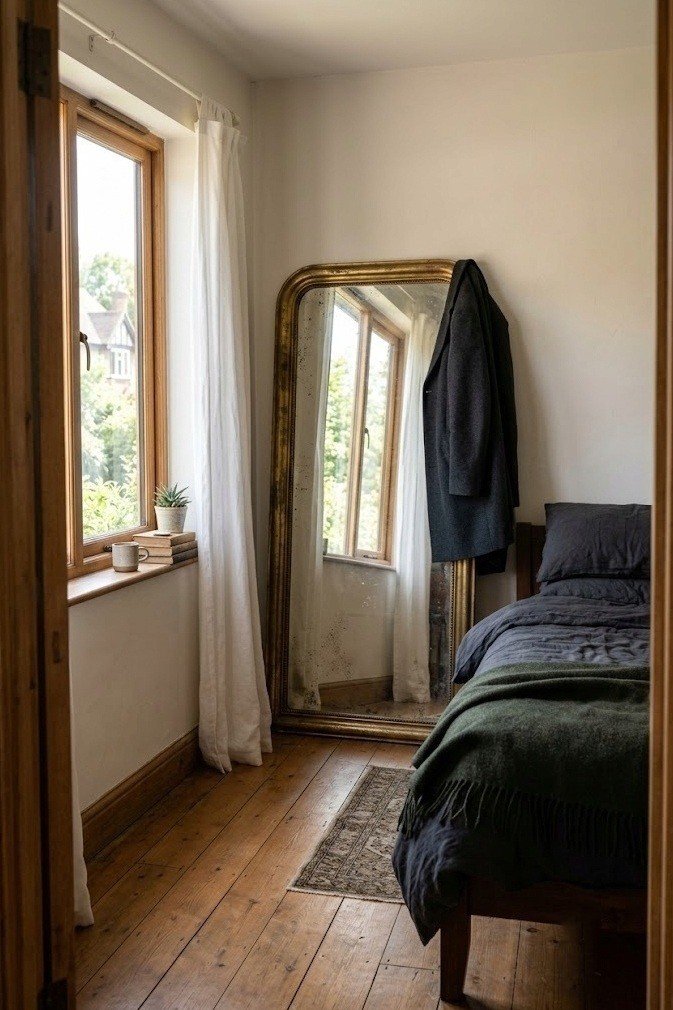
SaveOne window means one direction of daylight, and dark walls absorb most of it. A mirror fixes that, but placement decides whether it works.
Beside the window, on the return wall, throws light deeper into the room. Directly opposite mostly bounces the glare straight back out the glass. A tall arched antique brass frame leaning against the wall also skips drilling entirely, though strap it if you've got cats, because they will test it.
15. Layer a sheer under the heavy drapes
 Save
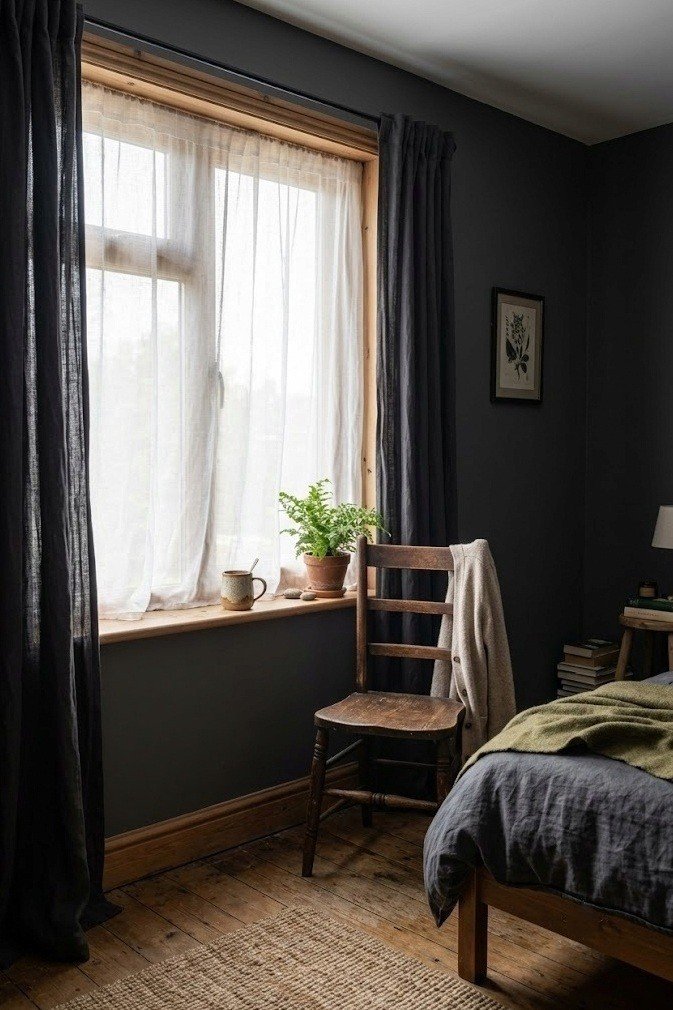
SaveFull blackout drapes in a sub-100 sq ft room with one window are overrated, and I'd skip them here specifically. Dark walls plus one window plus blackout fabric equals a cave at 2 in the afternoon, and around week three the aesthetic stops feeling cozy and starts feeling like a mood problem.
A sheer linen under-layer with the heavy panels pushed to the sides gives you the moody frame and usable daylight in the same window. Same setup, two completely different rooms depending on the hour.
Group 4: Furniture that earns its inches
16. Shop bookcases on depth, not width
 Save
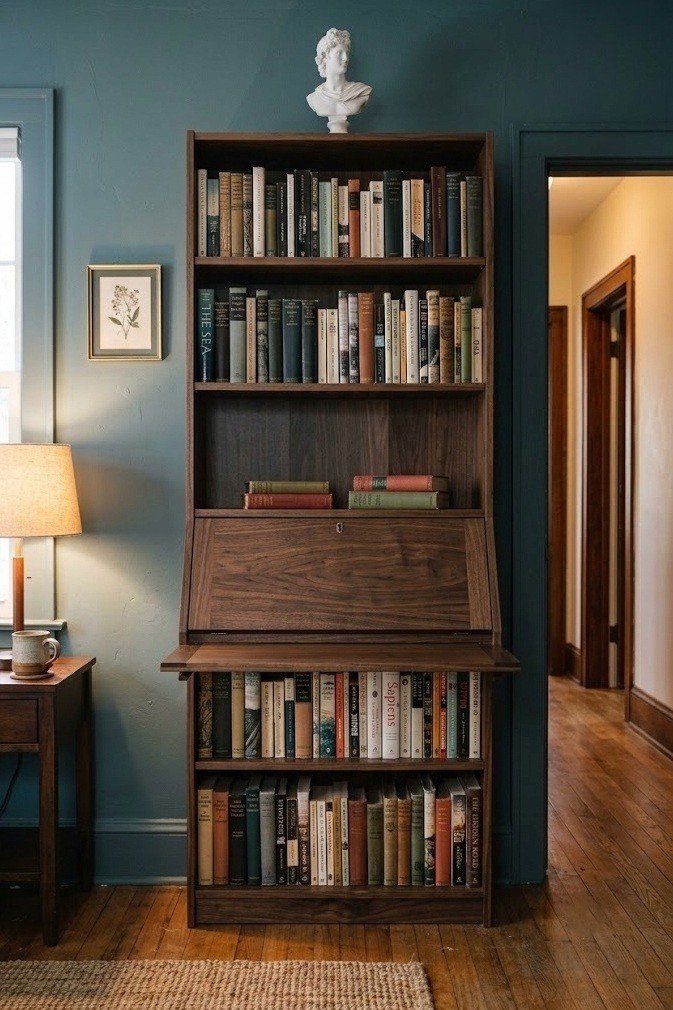
SaveStandard bookcases run around 16 inches deep. A 12 inch one still swallows hardcovers and hands you back 4 inches of walkway.
That's the spec to filter on, and nobody ever mentions it. Dark walnut over black, too. Black tends to go flat against an already dark wall, while walnut keeps some grain and warmth.
17. Round side table, not square
 Save
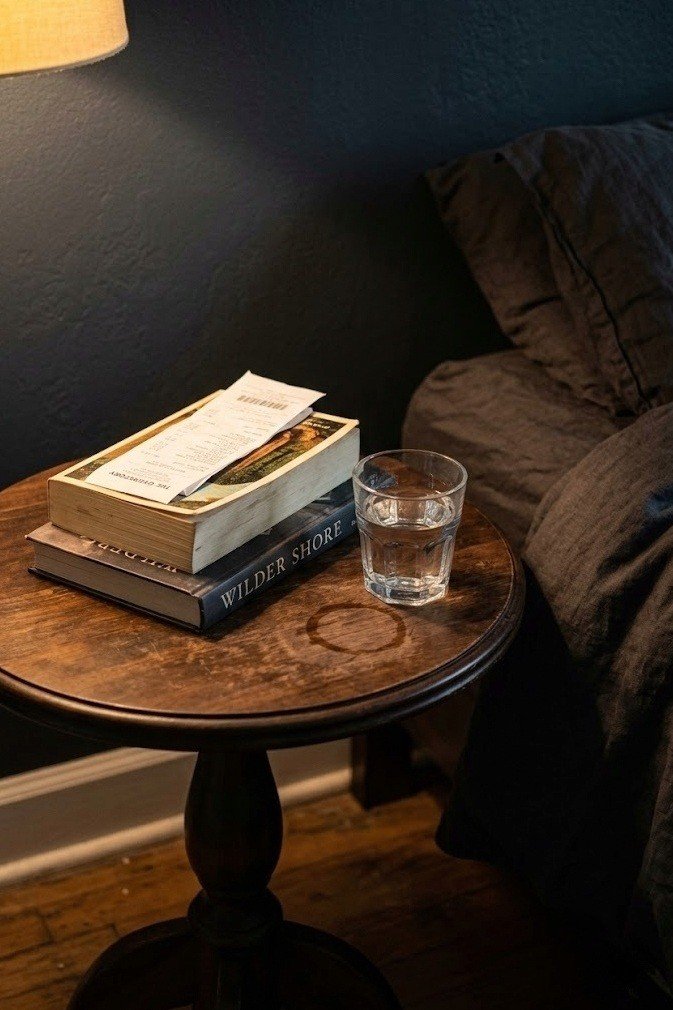
SaveRound beats square in a tight aisle. No corners to catch your hip on the way to the door. That's genuinely the whole reason.
18. Fold-down desk on the wall
 Save
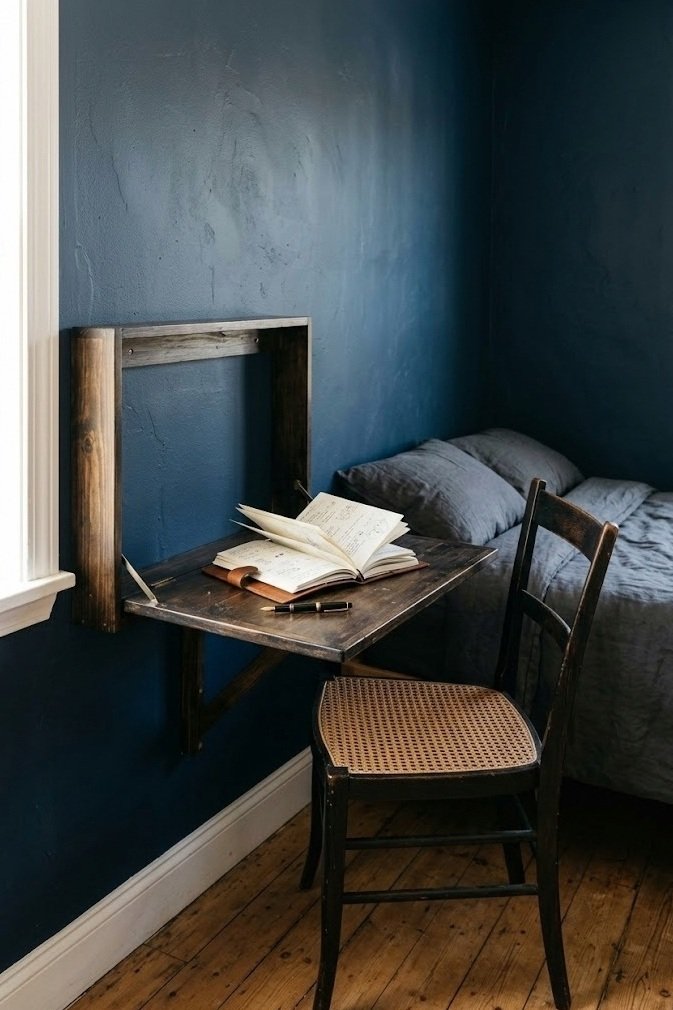
SaveA drop-leaf desk mounted to the wall is the only realistic way most sub-100 sq ft bedrooms get a work surface at all. Fold it up and your floor comes back.
Two things to get right: it has to go into studs, not anchors, because you'll be leaning on it. And mount it around 29 inches off the floor or your chair won't fit underneath. If the desk is really about reading rather than studying, the reading nook approach uses the same corner more comfortably.
19. Thrift a chair and use it as the nightstand
 Save
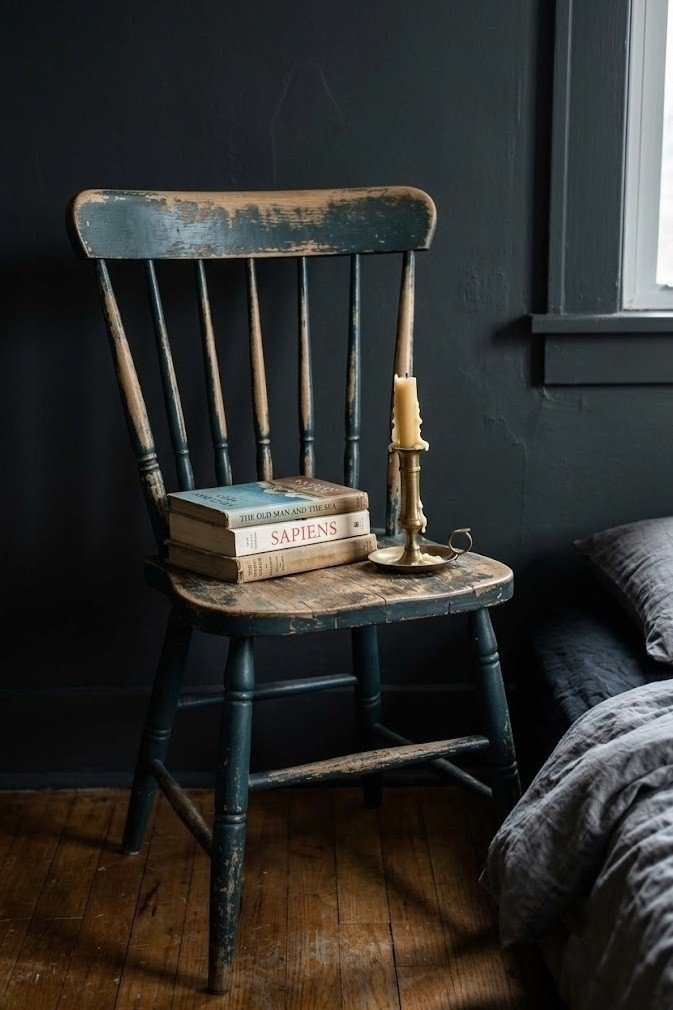
SaveI've seen worn spindle-backs going for eight bucks at estate sales. The worn finish is the point, don't sand it.
The seat holds a stack of books and a candlestick with room left over, and the whole thing weighs almost nothing, so you can move it when you inevitably rearrange the room in October.
20. The trunk at the foot of the bed, and the measurement nobody checks
 Save
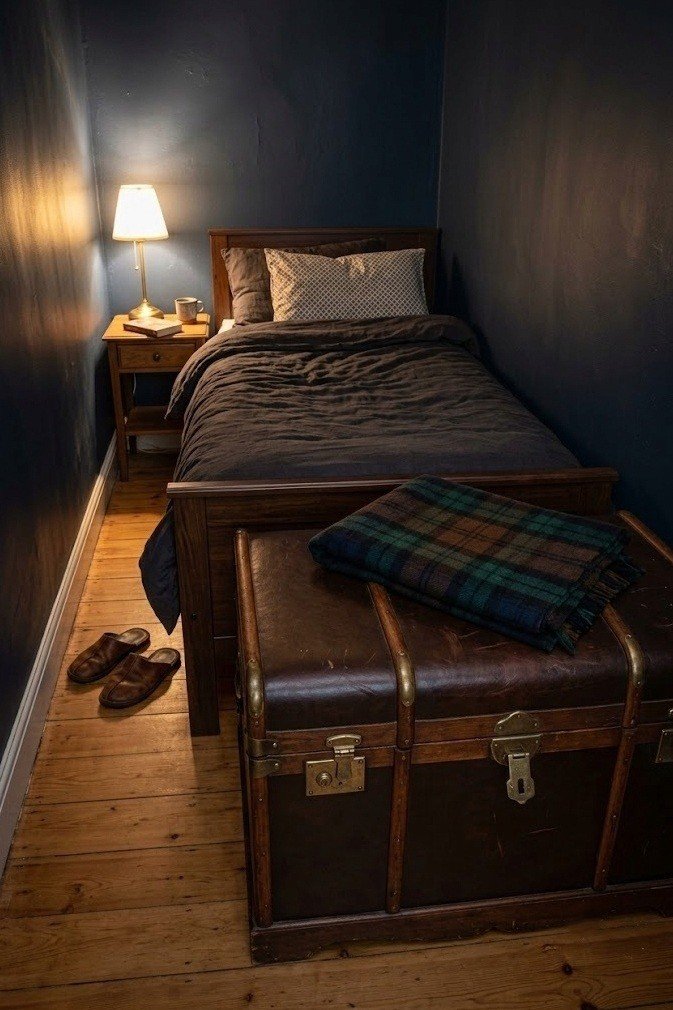
SaveEvery small-room post puts a trunk at the foot of the bed. Not one of them tells you to measure first.
Get the distance between your bed and the opposite wall. Under about 30 inches and that trunk turns your only walkway into a shin hazard, no matter how good it photographs. Clear 30 and it's probably the best storage-and-surface piece in the room.
September swap: folded plaid throw on the lid. That's the whole fall styling move for this corner.
FAQ
Can a small bedroom handle dark academia without feeling cramped?
Yes, and dark walls are actually part of the fix rather than the problem. Taking one deep shade across the walls, trim and ceiling removes the contrast lines your eye uses to measure the room, which is why designers use color drenching in small bedrooms specifically. What makes a small room feel cramped is high contrast and floor clutter, not dark paint.
What paint color works best for a small dark academia bedroom?
Benjamin Moore Hale Navy HC-154 is the safest first dark bedroom, deep but not aggressive under limited light. If you want something greener and moodier, Farrow & Ball Hague Blue leans teal, and Sherwin-Williams Urbane Bronze is the warm brown-gray alternative. Test a sample on the actual wall, since a single-window room shows a shade very differently at 9 a.m. and 6 p.m.
How much does a dark academia small bedroom cost?
It splits by execution level. No-drill swaps like bulbs, a picture ledge, floor book stacks and a thrifted chair land in the $0–$60 range each. Painting a small room yourself runs about $60–$150 in paint and supplies. Furniture-led pieces such as a narrow bookcase, a fold-down desk or a trunk are the $90–$320 line items, and those are the ones worth doing slowly.
Can renters do dark academia without painting at all?
Most of it, yes. Peel-and-stick wood plank paper, adhesive ledges, Command-strip gallery columns, ceiling-track drapes, a corner curtain and warm bulbs cover the aesthetic without a drop of paint. The only ideas here that truly need permission are the painted ones and the above-door shelf.
What bulb temperature should I use?
2700K throughout, with CRI 90 or above if the packaging tells you. Add a single 2200K bulb in one lamp from September onward for the candlelit fall version, and keep every other fixture matched at 2700K.
Quick-Pick Table
| Idea | Difficulty | Cost | Best for |
|---|---|---|---|
| #1 Drench wall and ceiling | Weekend project | $60–$150 | Owners, or renters with written painting permission, in rooms under 100 sq ft |
| #2 Peel-and-stick wood plank wall | Easy | $70–$140 for one wall | Renters with smooth untextured drywall |
| #3 Adhesive book ledge | Easy | $15–$30 | Book display in a room with no floor space left |
| #4 Vertical frame column | Easy | $40–$120 depending on how many frames you thrift | Low ceilings and narrow wall runs |
| #5 Trim and door in wall color | Weekend project | $25–$60 | Rooms where heavy white trim is chopping up the walls |
| #6 Floor book stacks | Easy | $0 | Zero budget and zero floor space |
| #7 Under-bed rolling crates | Easy | $40–$90 | Rooms with no closet or no room for a dresser |
| #8 Above-door book shelf | Weekend project | $20–$50 | Owners, or renters allowed to patch small holes |
| #9 Wall-mounted velvet headboard | Weekend project | $80–$250 | Tight walkways where a freestanding headboard steals inches |
| #10 Corner curtain over clothes rail | Easy | $35–$80 | Bedrooms with no closet at all |
| #11 Ceiling-track drapes wall to wall | Weekend project | $90–$220 | One small window in a room with low ceilings |
| #12 2700K bulbs, 2200K for fall | Easy | $15–$40 | Every dark room, this is the base layer before anything else |
| #13 Clip-on brass reading light | Easy | $18–$45 | Rooms with no floor space for a nightstand |
| #14 Arched mirror beside the window | Easy | $60–$250 depending on secondhand or new | Rooms with one window and daylight from a single direction |
| #15 Sheer under-layer | Easy | $30–$70 | Anyone who is actually home during daylight hours |
| #16 Twelve inch deep bookcase | Easy | $90–$300 | Walkways under 30 inches wide |
| #17 Round pedestal side table | Easy | $40–$150 | Tight aisles beside the bed |
| #18 Fold-down wall desk | Weekend project | $120–$320 | Getting a study surface into a room with no floor for a desk |
| #19 Thrifted chair as nightstand | Easy | $8–$45 secondhand | Very small budgets and light bedside needs |
| #20 Trunk at the foot of the bed | Easy | $70–$300 | Rooms with at least 30 inches between the bed and the opposite wall |
Tips
The September swap list, in full. One 2200K bulb in one lamp. The plaid wool blanket out of the under-bed crate. A folded throw on the trunk lid. Swap the cotton bedding for flannel or brushed cotton if you've got it. That's four moves, and it's genuinely all the seasonal change a small room can absorb before it starts looking busy.
Measure before you buy anything with a footprint. Bed to opposite wall, bed to the nearest side wall, and clearance under the mattress. Three numbers written in your phone will save you two returns.
Match your bulb temperature across every fixture. One cool bulb in a warm room is more noticeable in a small space than in a big one, because you see every light source at once.
Do the walls before the furniture. Dark walls change what furniture reads as, and a piece that looked too heavy against white often looks right against navy. Buying furniture first is how people end up with three things that don't work together.
Let the clutter be intentional. Dark academia tolerates a stacked, collected mess better than almost any other aesthetic, but in a small room the mess has to stay off the floor. Vertical clutter reads as character. Floor clutter just reads as small.
If your constraint is really the lease rather than the square footage, these renter-friendly small bedroom ideas come at it from the other direction.
Final Thoughts
The short version: your room being small isn't the obstacle, and going dark isn't the risk everyone treats it as. Drench one color across the walls and ceiling, get everything you can off the floor and onto the walls, put 2700K in every socket, and let one window do its job behind a sheer instead of a blackout panel.
Start with the bulbs, honestly. It's the cheapest thing here and it changes the room the same evening. Then pick the one wall you're willing to commit to and go from there.
Save the ones you want, and if you get the drenched wall done before October, that's the whole fall handled.